
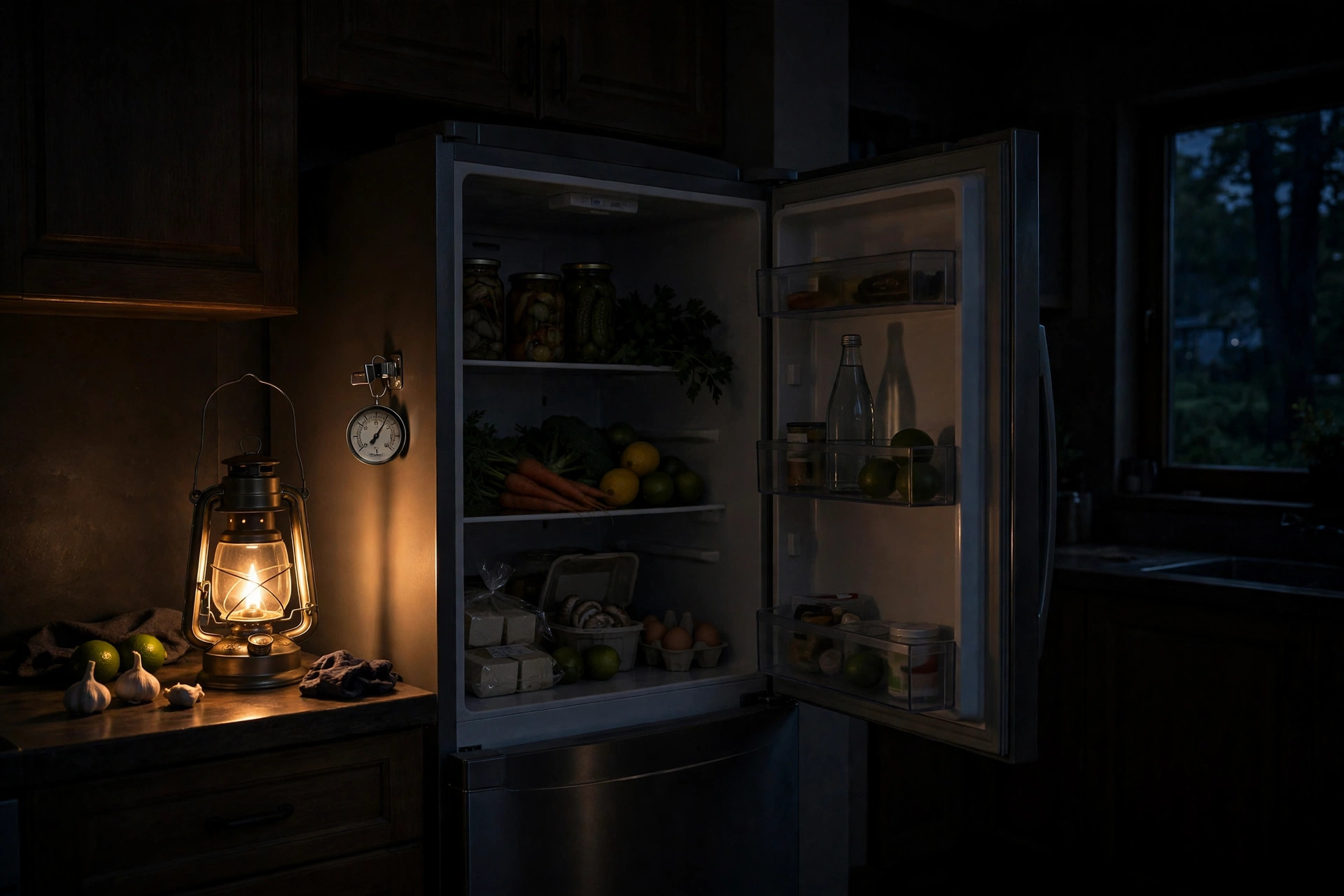
A fridge full of food starts dying the moment the power cuts – but slower than you think, if you do the right things and, mostly, don’t do the wrong ones. Food safety agencies give clear numbers for this situation. Here is the timeline, the tricks that stretch it, and the point where honesty beats hope.
The clock you are working against
- An unopened fridge keeps food at a safe temperature for about 4 hours.
- A full freezer holds its temperature for about 48 hours; a half-full one about 24 hours. Full is better – frozen food insulates itself.
- The safety lines are 40°F (4°C) for the fridge and 0°F (-18°C) for the freezer. Perishable food that has sat above 40°F for more than 2 hours should be discarded. When in doubt, throw it out – food poisoning is a terrible addition to a power outage.
You cannot manage what you do not measure: a cheap fridge/freezer thermometer turns guessing into knowing, and it costs less than the milk you will save once.
Stretch the timeline: before and during the outage
Before storm season: freeze gallon jugs of water (leave headspace) and keep them in the freezer permanently. They hold the cold for hours longer, and as they melt they become drinking water – which ties straight into your stored water plan. Keep the freezer full; fill gaps with those jugs.
During the outage: the door is the enemy. Every opening dumps cold air you cannot replace. Decide what you need, take it out in one trip, and cook perishables first – fridge food, then freezer food, then pantry. Group items together inside (a huddle holds cold better), and if the outage stretches, move the most valuable perishables into a hard cooler packed tight with your frozen jugs or ice – a good cooler buys another day or more.
Power the fridge back up, strategically
If you own a portable power station from our backup power guide, you do not need to run the fridge continuously. Compressors cycle: run the fridge for an hour or two until it is properly cold again, then unplug and let insulation and your frozen jugs carry it for several hours. That rotation can stretch a mid-size power station across days of fridge protection while still keeping phones and lights alive. Generators do the same job louder, run outdoors only, per the safety rules in the power guide.
And the honest endgame: at some point in a long outage, the correct move is a cook-up – turn the thawing meat and vegetables into one big shared meal – followed by the bin for anything questionable. A stocked pantry of the shelf-stable food from our food storage guide is exactly what carries you after that point. The fridge is day one. The pantry is the plan.
As an Amazon Associate, Alien Bunker earns from qualifying purchases. This page contains affiliate links, which support the site at no extra cost to you.