
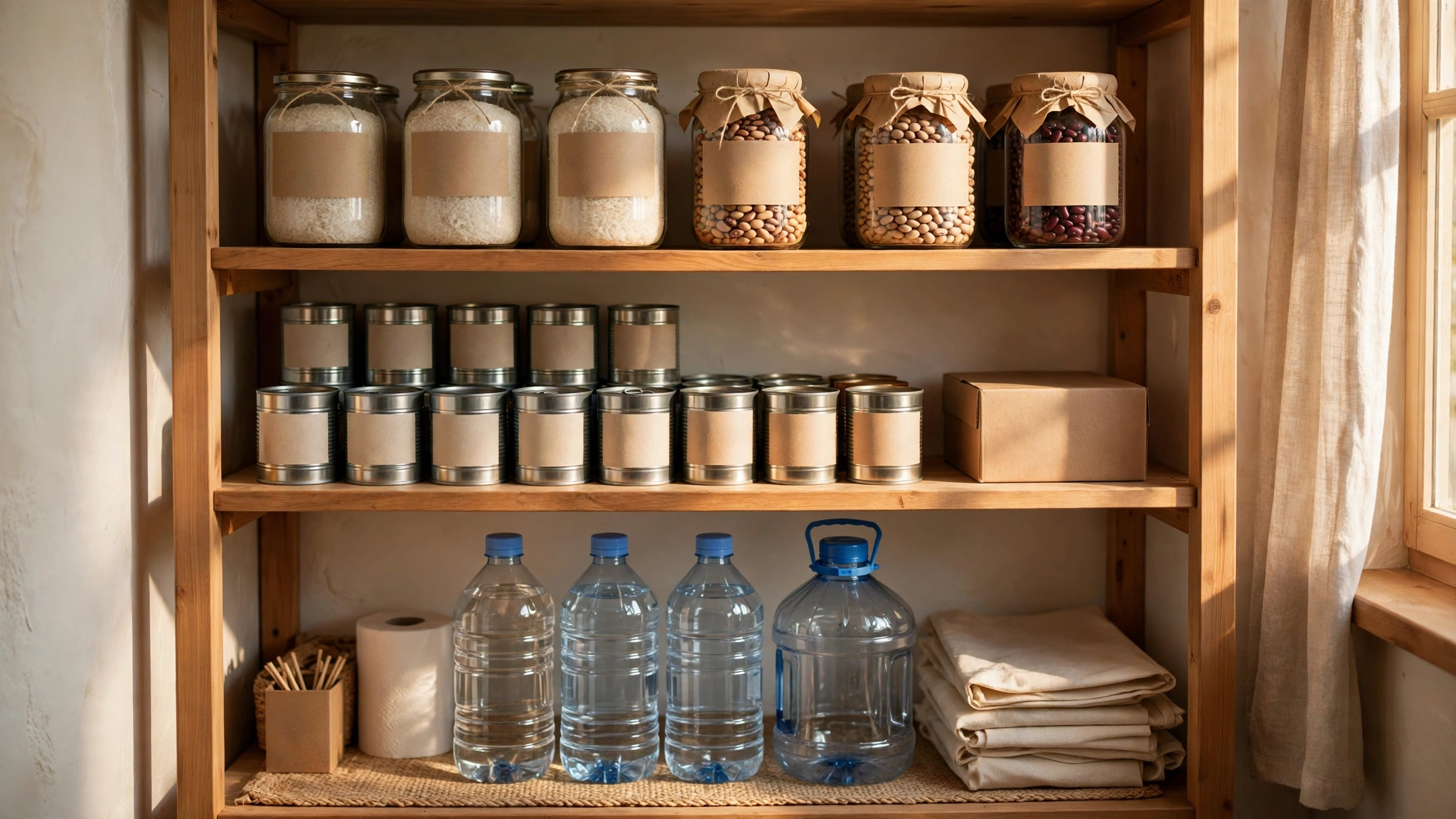
Emergency food storage sounds like something for people with bunkers and beards. In reality it is just groceries, bought a little ahead of time, stored on purpose. If a storm, a blackout, or a supply hiccup emptied your local store shelves tomorrow, a calm 30-day supply means you shrug instead of queue. This guide builds that supply step by step – cheaply, in a normal kitchen, without buying a single thing you will never eat.
How much food is 30 days, really?
Plan on roughly 2,000 calories per adult per day. Thirty days is about 60,000 calories per person – a useful number, because it turns “a lot of food” into a shopping list. For two adults you are aiming near 120,000 calories, plus water (below). You do not need to hit it in one trip. Most people build it in four weekly shops of about $40-$60.
The golden rule: store what you eat, eat what you store
Survival rations you hate will still be sitting there in five years, untouched and expired. Instead, stock deeper versions of your normal pantry: the rice you already cook, the pasta sauce you already like, the oats you already eat. Rotation becomes automatic because dinner keeps cycling the stock. Every item in this guide is ordinary supermarket food.
The backbone: dry staples
- White rice – the cheapest calorie on Earth, stores 10+ years sealed and dry. Long grain, jasmine, basmati: whichever you actually cook.
- Dry beans and lentils – lentils are the star: no soaking, cooks in 20 minutes. Add black beans, kidney beans or chickpeas for variety.
- Rolled oats – breakfast for pennies, and they double as a base for granola and baking.
- Pasta and flour – pasta stores for years; flour for about a year in the pantry, longer frozen.
- Peanut butter – calorie-dense, no cooking, morale in a jar.
A practical 30-day backbone for one adult: 10 kg rice, 5 kg beans/lentils, 3 kg oats, 4 kg pasta, 2 kg peanut butter. Adjust to your household’s real habits, not to a spreadsheet fantasy.
The supporting cast: cans, jars and flavor
Dry staples alone will keep you alive and miserable. Round them out with canned tomatoes, corn and fruit, tuna or other canned protein, soup, cooking oil, salt, sugar or honey, coffee or tea, and the spices and hot sauce that make simple food taste like dinner. Flavor is not a luxury in an emergency – it is what keeps people eating properly. Budget roughly a third of your spending here.
Freeze-dried meals: the insurance layer
Commercial freeze-dried meals (the kind sold as emergency food supply buckets) keep 20-30 years, need only hot water, and taste surprisingly decent. They are also the most expensive calories you can buy. Our take: treat them as a top-up layer, not the foundation – a few days’ worth for the “no cooking possible” scenario, on top of your cheap supermarket staples.
Do not forget water
Food without water is a paperweight. Store at least 4 liters per person per day for drinking and basic cooking – that is 120 liters per person for 30 days, which is more than most apartments can hold. A realistic compromise: store 7-14 days of water in stackable containers and add a quality gravity water filter for everything beyond that. Water strategy deserves its own plan; we will cover it in depth in our water storage guide.
Storage rules that actually matter
- Cool, dark, dry. A closet beats a garage. Heat is the enemy of shelf life.
- Off the floor, sealed against pests. Transfer rice and flour into food-grade buckets or heavy bins with tight lids.
- Label with the month and year in marker. Future you says thanks.
- FIFO: first in, first out. New stock goes at the back; meals come from the front. This single habit eliminates most waste.
The 4-week building plan
- Week 1: Rice, oats, peanut butter, salt, oil. Plus your water containers.
- Week 2: Beans and lentils, pasta, flour.
- Week 3: Canned goods – tomatoes, vegetables, fruit, tuna, soup.
- Week 4: Flavor and morale – spices, honey, coffee, hot sauce, plus a small freeze-dried top-up.
Beginner mistakes to skip
- Buying 50 kg of wheat berries with no mill and no plan. Store food you can cook tonight.
- Forgetting a manual can opener. (Everyone does it once.)
- All carbs, no protein or fat. Add beans, canned fish and peanut butter early.
- Storing everything in one place. A small secondary stash beats one flood-prone closet.
Next step: once your 30 days of food is underway, build the kit that covers the first 72 hours of anything – our guide to building a 72-hour emergency kit for a small apartment shows you how, closet and all.
As an Amazon Associate, Alien Bunker earns from qualifying purchases. This post contains affiliate links – if you buy through them, we may earn a small commission at no extra cost to you.
Pair your food supply with water – see our beginner’s guide to emergency water storage and purification.