
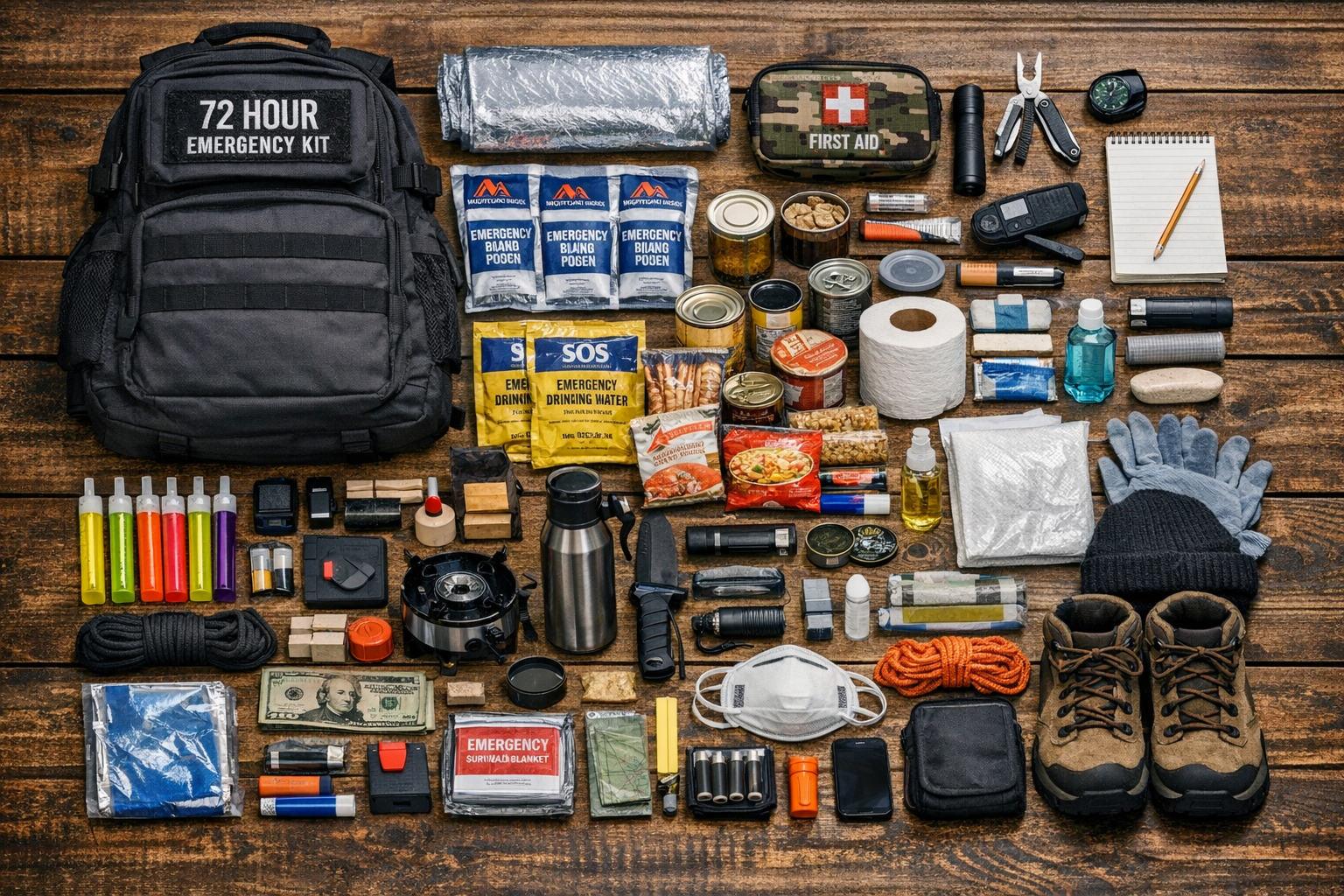
Most emergency guides assume you have a garage, a basement, and a pickup truck. You don’t. Here’s how to actually prep when your entire living situation fits inside 500 square feet.
This post contains affiliate links — I may earn a small commission if you buy through them.
Why 72 Hours? Why Not More?
Emergency management agencies worldwide — including FEMA in the US and Japan’s Cabinet Office — recommend that every household be self-sufficient for a minimum of 72 hours after a disaster. That’s the window before rescue services, supply chains, and utilities typically begin to stabilize.
For apartment dwellers, 72 hours is also a realistic target. You’re not building an underground bunker. You’re building a survival buffer — enough to ride out an earthquake, blackout, storm, or grid failure without leaving your home or relying on anyone else.
After 72 hours, you reassess. But those first three days are the most chaotic, and being prepared for them is the difference between riding it out calmly and panicking in a dark hallway.
The Small Apartment Problem (And Why It’s Actually Easier Than You Think)
Traditional prepper advice is built for people with space. Store a year’s worth of food. Buy a generator. Fill your garage with water barrels.
That advice is useless if you live in an apartment.
But here’s the flip side: a 72-hour kit for one or two people is compact. Everything you need fits in a single backpack and a small storage bin under your bed. No garage required. No special shelving. No dedicated “prepper room.”
The goal is simple: water, food, light, power, first aid, and information — for 72 hours — in a space the size of a carry-on bag.
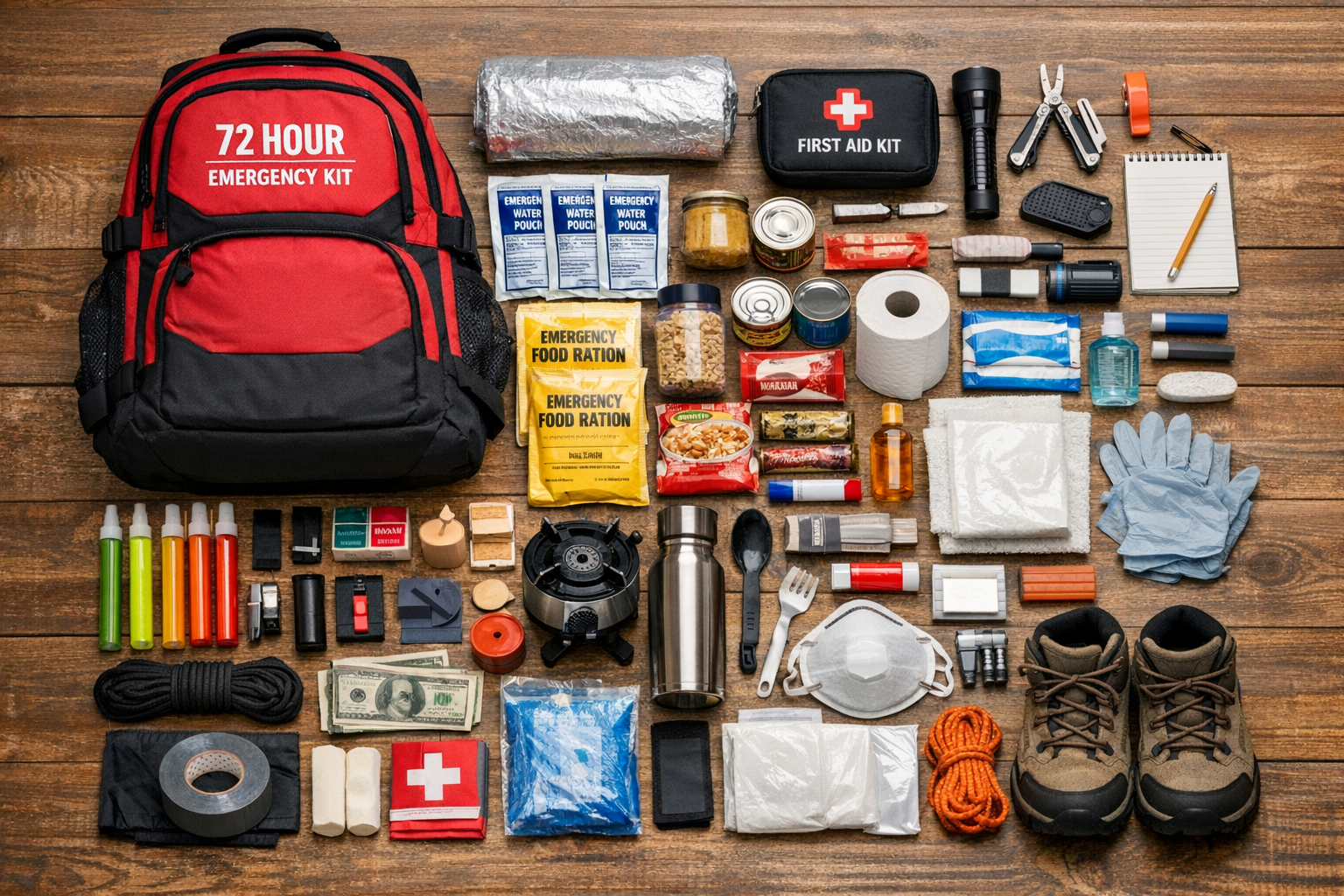
What You Actually Need: The Core 6 Categories
1. Water
Water is non-negotiable and always the first priority.
How much: The standard recommendation is 1 gallon per person per day. For a solo person over 72 hours, that’s 3 gallons. For two people, 6 gallons.
What to store it in:
- Pre-filled water pouches (compact, stackable, 5-year shelf life) — [https://amzn.to/47V9SnI]
- A collapsible water container you fill from the tap before a known storm — [https://amzn.to/4vtVlZY]
- Water purification tablets as a backup — [https://amzn.to/4vmTmqp]
Apartment tip: Store water under the bed, in a closet corner, or behind furniture. Water pouches are flat enough to slide under most bed frames.
Don’t forget: If you get warning before a disaster (storm incoming, typhoon warning, etc.), fill your bathtub immediately. A standard bathtub holds 80–100 gallons. There are also bathtub water bladders designed specifically for this — [https://amzn.to/48JsxTw].
2. Food
You don’t need freeze-dried gourmet survival meals (though they exist and they’re decent). For 72 hours, you need food that requires no cooking, no refrigeration, and minimal water.
Practical options:
- Energy bars (Clif, Kind, or dedicated survival bars) — [https://amzn.to/3Q98esr]
- Canned goods with a pull-tab top (tuna, beans, soup)
- Peanut butter packets
- Crackers, nuts, dried fruit
- Instant oatmeal packets (only if you have a way to boil water)
How much: Roughly 2,000 calories per person per day. For 72 hours solo, that’s about 6,000 calories total — achievable with a modest stash.
Apartment tip: Rotate your emergency food into your regular pantry every 6–12 months so nothing expires. Treat it like a “use it before you need it” policy.
3. Light
In a blackout, your phone flashlight dies in hours. Your apartment becomes completely dark at night. Light is more psychologically important than most people realize — panic spikes in darkness.
What to have:
- A quality hand crank + solar flashlight — [https://amzn.to/4c9tdnv]
- Battery-powered LED lantern for ambient light — [https://amzn.to/4vsULM8]
- Extra batteries (AA and AAA — know which your devices use)
- Glow sticks as a no-battery backup — [https://amzn.to/4spXsvb]
Apartment tip: Keep one flashlight on your nightstand and one in your kit. If a disaster hits at 3am, you want light before you’ve even thought about your emergency bag.
4. Power and Communication
Your phone is your lifeline — for news, emergency alerts, maps, and contacting people. Keeping it charged during a multi-day blackout is critical.
What to have:
- A high-capacity portable power bank (20,000mAh minimum) — [https://amzn.to/4mCuBCH]
- A hand crank emergency radio with NOAA weather alerts — [https://amzn.to/4cijpq8]
- A solar charging panel for extended outages — [https://amzn.to/4dQMADf]
Why the radio matters: During serious disasters, cell towers overload or go down entirely. A battery or hand crank emergency radio that picks up government emergency broadcasts is how you get real information when the internet is gone.
Apartment tip: Keep your power bank charged at 80%+ as a habit. Plug it in once a month if you don’t use it regularly.
5. First Aid
Hospitals get overwhelmed during disasters. Minor injuries become serious problems if untreated. A solid first aid kit is not optional.
A basic apartment kit should include:
- Adhesive bandages (multiple sizes)
- Gauze and medical tape
- Antiseptic wipes and antibiotic ointment
- Tweezers and scissors
- Disposable gloves
- Pain reliever (ibuprofen, acetaminophen)
- Any personal prescription medications (keep a 3-day supply rotated in your kit)
- A first aid manual
You can buy a pre-assembled kit — [https://amzn.to/424ngCl] — or build your own. Building your own is cheaper and lets you customize for your household’s needs.
Apartment tip: If you take daily medication, this is the most important thing to think about. A 72-hour gap in critical medication is a medical emergency on its own. Talk to your doctor about maintaining an emergency supply.
6. Documents and Cash
This category gets skipped most often and causes the most stress when disaster actually hits.
What to prepare:
- Copies of your ID, passport, insurance documents, and emergency contacts in a waterproof bag — [https://amzn.to/4svSlK4]
- A USB drive with digital copies of important documents
- Cash in small bills — ATMs go offline and card readers stop working during blackouts. Have at least $100–$200 in small denominations.
Apartment tip: Keep a laminated card with emergency contacts in your kit. When you’re panicked, finding a phone number in your contacts takes longer than you think.
The Container: What to Store It All In
For an apartment, you have two smart options:
Option A: The Backpack Kit Pack everything into a quality backpack. This doubles as a bug-out bag if you need to leave your apartment quickly. Look for a 30–40L backpack with a hip belt for weight distribution — [https://amzn.to/3O4Fws9].
Option B: The Under-Bed Bin + Backpack Combo Keep bulkier items (water, extra food, lantern) in a flat storage bin under your bed — [https://amzn.to/3OyvO1j]. Pack the essentials you’d grab quickly (documents, power bank, first aid, flashlight, energy bars) in a backpack nearby.
Option B works better for most apartment situations because it separates “shelter in place” supplies from “grab and go” supplies.
The Complete Apartment 72-Hour Kit Checklist
Water
- [ ] 3 gallons of water per person (pouches, bottles, or jugs)
- [ ] Water purification tablets
- [ ] Collapsible water container
- [ ] Bathtub water bladder (optional but recommended)
Food
- [ ] 6,000 calories of non-perishable food per person
- [ ] Manual can opener
- [ ] Disposable utensils
Light
- [ ] Hand crank / solar flashlight
- [ ] LED battery lantern + extra batteries
- [ ] Glow sticks
Power and Communication
- [ ] 20,000mAh+ power bank (fully charged)
- [ ] Hand crank emergency radio
- [ ] USB charging cables for your devices
- [ ] Solar charging panel (optional)
First Aid
- [ ] Comprehensive first aid kit
- [ ] 3-day supply of personal medications
- [ ] First aid manual
Documents and Cash
- [ ] Copies of ID, passport, insurance in waterproof bag
- [ ] USB drive with digital copies
- [ ] $100–$200 in small bills
- [ ] Laminated emergency contact card
Extras Worth Adding
- [ ] Dust masks or N95 respirators (earthquakes, fire smoke)
- [ ] Work gloves (debris, broken glass)
- [ ] Mylar emergency blankets — [https://amzn.to/4vpFQCs]
- [ ] Whistle (signal for help if trapped)
- [ ] Multi-tool or Swiss Army knife — [https://amzn.to/4vtSmAM]
- [ ] Basic toiletries and sanitation supplies
Apartment-Specific Scenarios to Plan For
Earthquake: The most likely serious disaster for apartment dwellers in seismically active areas. Focus on: securing heavy furniture to walls, knowing where your building’s gas shutoff is, identifying your evacuation route, and having sturdy shoes near your bed (broken glass is the #1 injury source post-quake).
Extended Blackout: Focus on: phone charging, emergency lighting, food that doesn’t need cooking, and staying informed via hand crank radio.
Mandatory Evacuation: Your backpack kit should be grab-and-go ready at all times. Know two exit routes from your building. Know where your nearest emergency shelter is located.
Water Disruption: Your stored water becomes your only supply. This is why 3 gallons minimum is not negotiable.
How Long Will This Take to Build? How Much Will It Cost?
Time: You can build a solid 72-hour kit in one afternoon of online shopping and one trip to a pharmacy or dollar store.
Cost: A complete kit for one person runs approximately $80–$150 depending on what you already own. That’s roughly the cost of two or three restaurant meals — for three days of self-sufficiency in any emergency.
Build it in phases if budget is a concern. Start with water and light this week. Add food and power next week. First aid and documents the week after.
Resuming
The difference between someone who panics in a disaster and someone who doesn’t usually comes down to one thing: did they spend one afternoon thinking about this before it happened?
A 72-hour kit doesn’t make you a doomsday prepper. It makes you someone who thought ahead. In an apartment, that takes less space than a carry-on bag and less money than a console game.
Build it once. Maintain it twice a year. Hope you never need it.
Looking for more apartment preparedness guides? Explore our other articles for practical, no-nonsense survival prep built for people who live in the real world.
