
When the grid goes down, the clock starts on everything in your fridge, every phone battery in the house, and – if someone relies on a CPAP or powered medical device – something much more serious. Backup power sounds like a rich person’s hobby until you price out a blackout: spoiled food, a hotel night, lost work. A basic setup costs less than one bad outage. Here is how to size it, what to buy first, and the safety rules that are not optional.
Step one: do the watt math (it is simpler than you think)
Everything runs on one formula: watts x hours = watt-hours (Wh). A battery’s capacity is measured in watt-hours, so you just add up what you want to run, and for how long. Typical draws:
- Phone charge: about 10-15 Wh per full charge
- LED light bulb or lantern: 5-10 watts
- Laptop: 50-90 watts while charging
- CPAP machine: typically 30-60 watts (much less with the heated humidifier off)
- Full-size fridge: 100-200 watts while the compressor runs, and it cycles on and off – figure roughly 1,000-1,500 Wh per day
- Wi-Fi router: about 10 watts – small draw, huge quality-of-life
So a 500 Wh battery runs the lights, phones, router, and a CPAP through the night comfortably – but only keeps a fridge cold for a few hours. A 2,000 Wh unit handles the fridge for a day or more. That one calculation tells you exactly which tier you need.
Tier 1: Power banks and rechargeable lights (under $100)
Start where everyone should: a couple of large portable power banks and rechargeable LED lanterns. This tier covers light and communication – the two things that make the first night of an outage stressful – and it is already in our 72-hour apartment kit for a reason. Cheap, silent, apartment-proof.
Tier 2: Portable power stations (the sweet spot)
A portable power station is a big battery with real wall outlets, USB ports, and a display that tells you exactly how much runtime is left. No fuel, no fumes, no noise – safe to run in a bedroom, which is why it beats a generator for most homes and is the only real option for apartments. Buy by the math you did above: 300-500 Wh for lights/phones/CPAP, 1,000 Wh and up if the fridge matters.
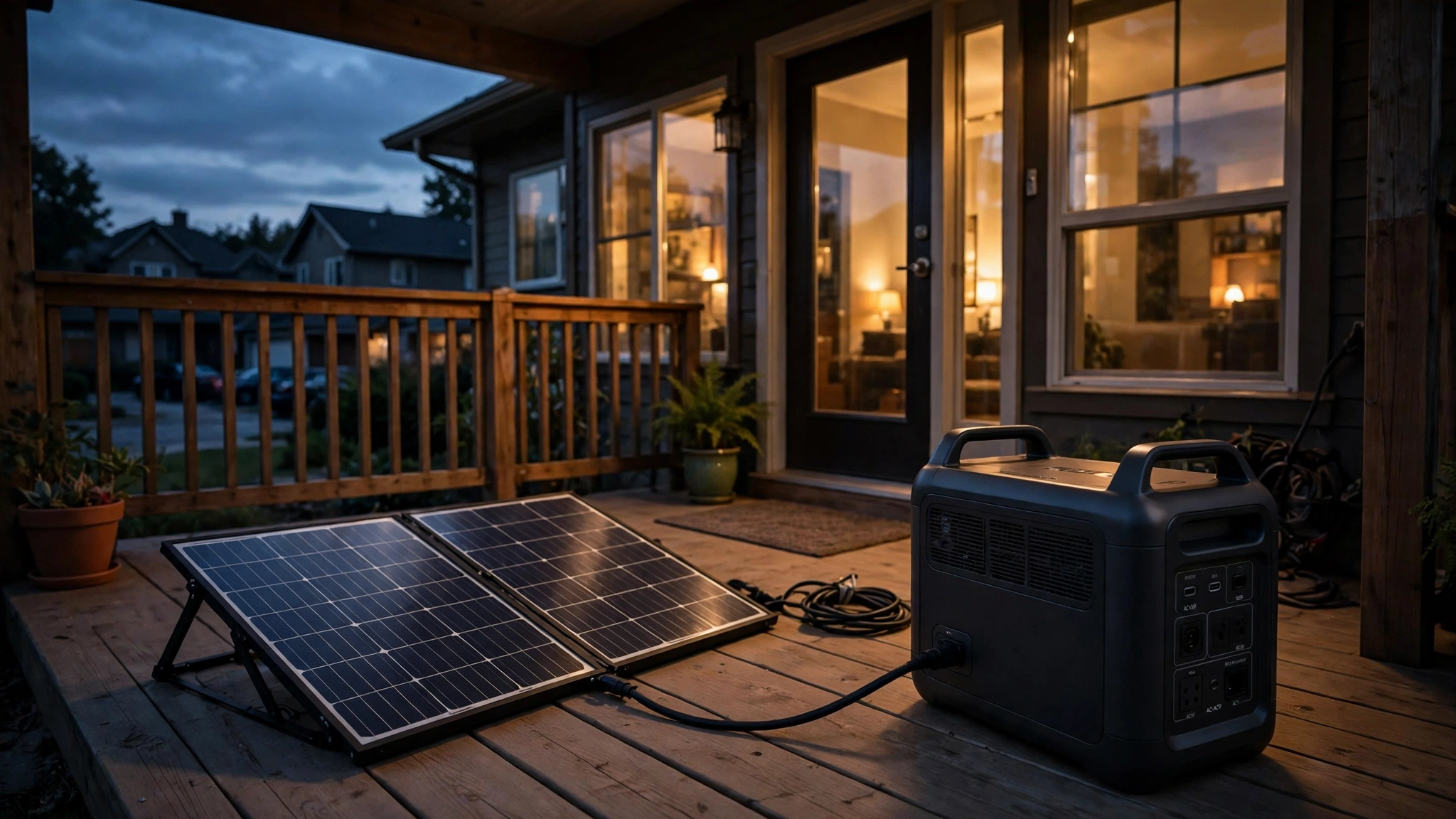
Add a folding solar panel and the station becomes a small solar generator: it recharges while it powers your day. Be realistic about solar – a 100W panel gives you roughly 60-80 watts in good sun, so expect a few hundred watt-hours on a decent day, not a full recharge. Even so, solar turns a two-day battery into an indefinite supply for lights, phones, and radios. Priorities change; sunlight keeps coming.
Tier 3: Generators (most power, strictest rules)
Nothing beats a generator for whole-house loads – well pumps, furnaces, multiple fridges. An dual-fuel inverter generator is the smart buy: inverter models are quieter and sip fuel, and dual-fuel lets you run propane, which stores for years without going stale like gasoline.
The safety rules are absolute, because carbon monoxide kills people in every major outage: never run a generator indoors, in a garage, or near an open window. Run it outside, at least 20 feet from the house, exhaust pointed away. Let it cool before refueling. If you want it wired into your home circuits, that is a licensed electrician and a transfer switch – backfeeding through an outlet can electrocute line workers and start fires. No exceptions, no shortcuts.
What to buy first
Work up the tiers in order. Tier 1 this week – it is cheap and covers the most common short outages. Tier 2 next, sized by your watt math; it is the single biggest resilience upgrade most households can make. Tier 3 only if you own the space to run it safely. And remember that power is one leg of the system: pair it with two weeks of stored water and a 30-day food supply, and a grid failure becomes an inconvenience instead of an emergency. That is the whole point of the bunker.
As an Amazon Associate, Alien Bunker earns from qualifying purchases. This page contains affiliate links, which support the site at no extra cost to you.