
When the power goes out, your phone becomes your radio, your torch, your map, and your way to call for help — and it becomes all of those things on a battery that was never designed to last days. A solar charger sounds like the perfect fix: free power from the sun, no outlet required. It can be, but only if you buy the right kind and understand its limits. A bad solar charger is worse than no charger, because it gives you false confidence and a dead phone at the worst moment.
Two different products, one confusing name
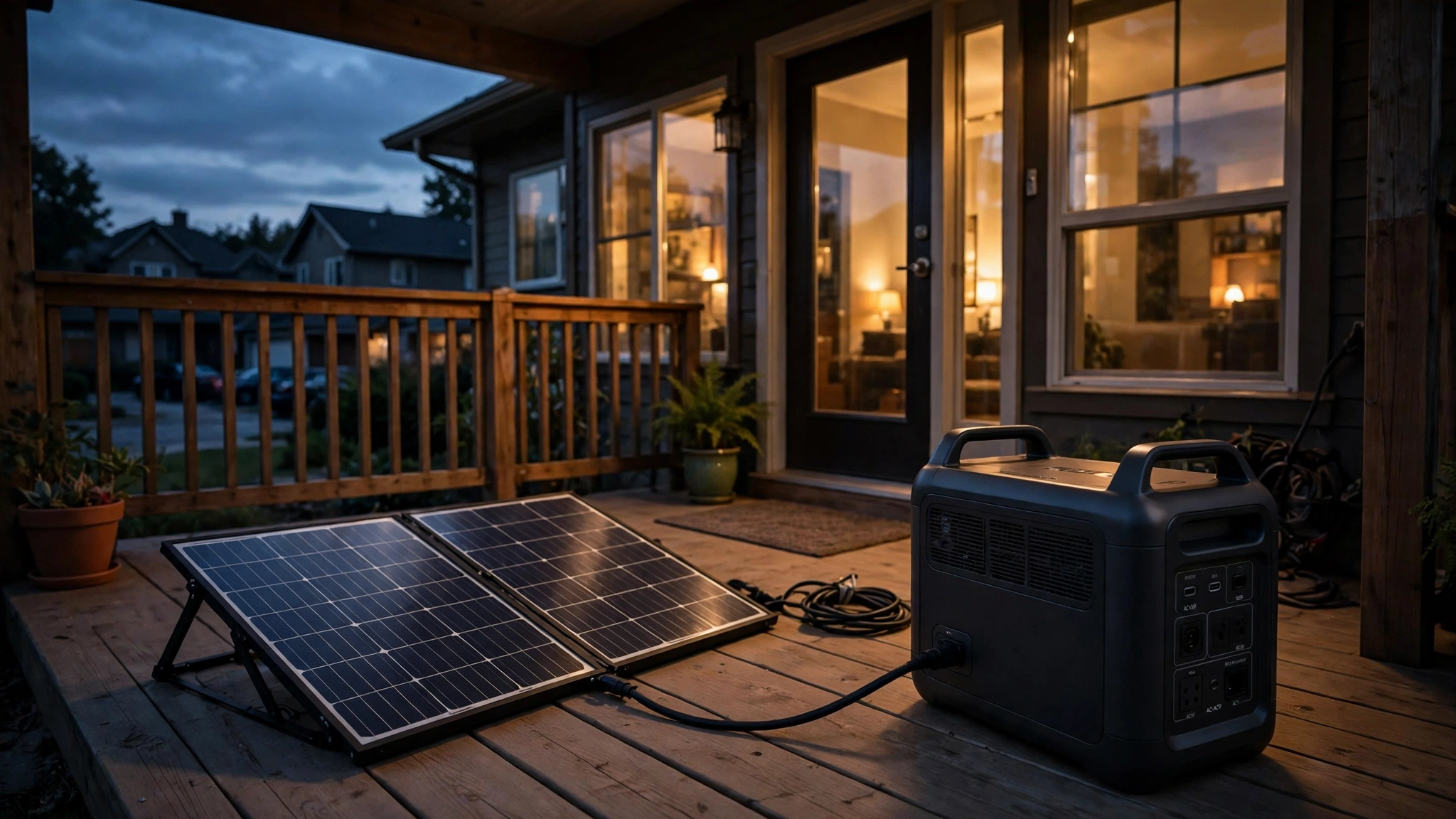
“Solar charger” covers two very different things. The first is a small solar panel that charges devices directly while the sun shines. It works, but slowly, and only in direct sun — a panel the size of a book will not fast-charge a phone on a cloudy day. The second, and usually the better buy, is a power bank with a small solar panel built in, or a separate panel that charges a power bank. The power bank stores energy when the sun is out, and you charge your phone from the bank whenever you need it, including at night. For emergency use, the power bank route is almost always more practical: charge the bank during the day, use it at night, and never wait in the sun holding a phone to a panel.
What to look for
- Capacity, in plain terms: a power bank’s capacity is measured in milliamp-hours (mAh). A phone battery is roughly 3,000 to 5,000 mAh, so a 10,000 mAh bank charges a phone about twice, and a 20,000 mAh bank about four times, allowing for losses. For a household, 20,000 mAh is a sensible starting point.
- Panel size matters more than panel promises: a tiny panel on a power bank trickle-charges it over days, not hours. If solar is your main charging method, get a separate folding panel of a reasonable size, and use it to charge the bank, not the phone directly.
- Outputs: make sure the bank has the ports your household actually uses, and that it can charge more than one device if you have a family. A single-port bank becomes a queue during an outage.
- Durability: emergency gear gets dropped, rained on, and left in cars. A rugged case and some water resistance are worth more than a slim design.
The limits nobody puts on the box
Solar charging is slow, weather-dependent, and season-dependent. In winter, with short days and low sun, a panel produces a fraction of its summer output. Indoors, behind glass, output drops sharply — a panel on a windowsill is not the same as a panel in direct outdoor sun. And a solar charger does not replace a charged power bank: the correct emergency routine is to keep a power bank fully charged from the mains at all times, use it first during an outage, and use solar to top it up over days, not to rescue a dead phone in an hour. Pair solar with the other power options in our backup power guide, including a hand-crank radio with a phone-charging output for short top-ups.
A practical solar setup for a small home
Keep it simple: one 20,000 mAh power bank, charged from the mains and stored with your 72-hour kit, plus one folding solar panel if you expect outages longer than a couple of days or you spend time outdoors. Test the setup before you need it: put the panel in the sun, charge the bank, charge a phone from the bank, and time how long each step takes. That one test tells you more than any product page, and it reveals missing cables — the most common solar-charger failure of all. Keep the cables with the charger, in the same bag, always. A charger without its cable is a paperweight.
Finally, save phone battery aggressively during an outage: lower brightness, turn off background apps, use airplane mode when you do not need signal, and use a radio for news instead of streaming video. A solar charger stretches a phone battery; good battery habits stretch it further, and together they can keep a household connected through a long outage.
Shop the setup
- A solar power bank (20,000 mAh) — stored power with a solar top-up option.
- A folding solar panel — faster solar charging for a power bank.
- A large portable power bank — the mains-charged backup to use first.
As an Amazon Associate, Alien Bunker earns from qualifying purchases. This page contains affiliate links, which support the site at no extra cost to you.