
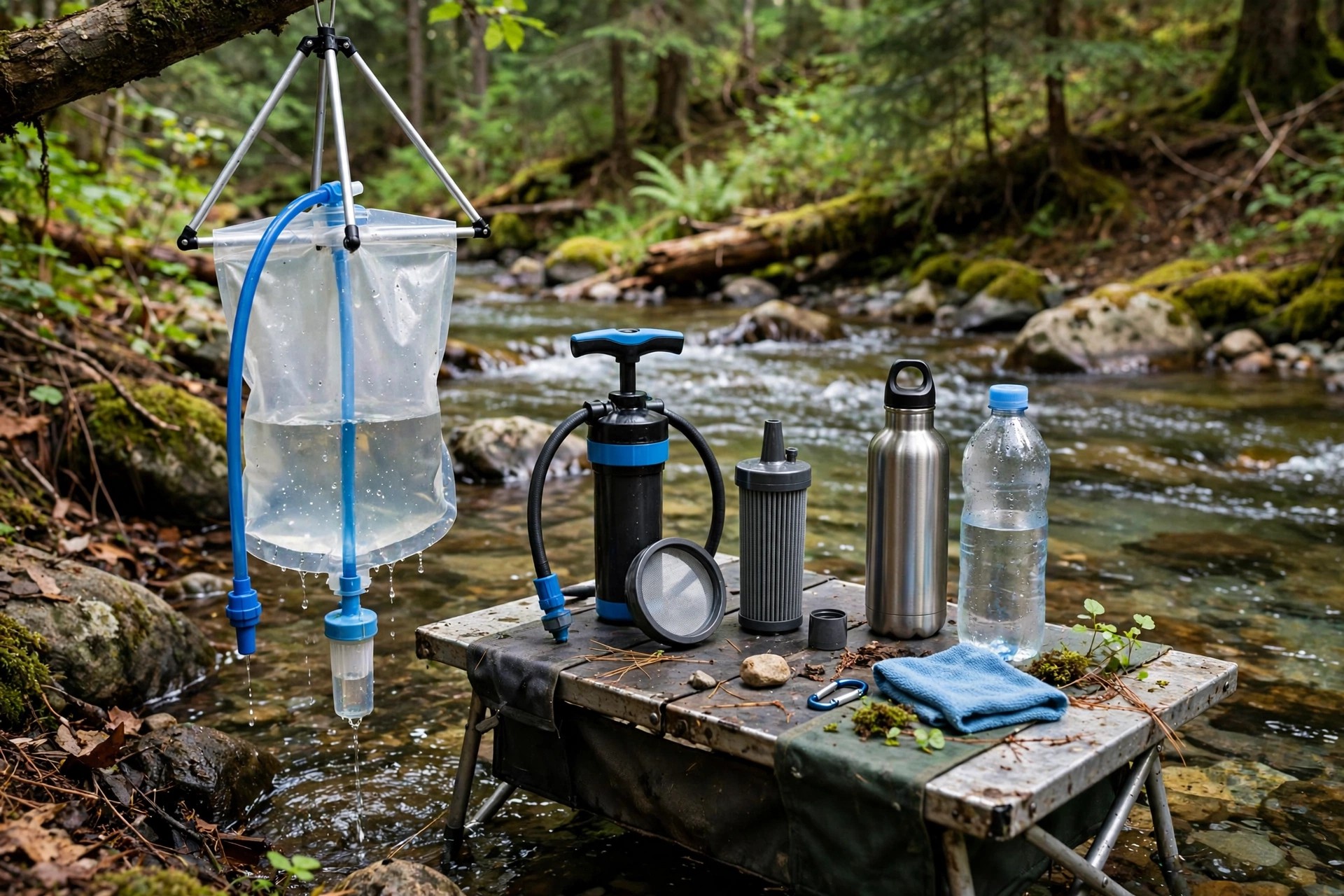
Clean water is the first thing that runs out in an emergency, and the hardest thing to replace. You can go days without food, but you cannot go days without water — and when the taps stop, the water you can find is not the water you can drink. Rivers, ponds, rainwater, and even a neighbour’s rain barrel can all carry bacteria, parasites, and sediment that will make you ill. A portable water filter straw is the smallest, cheapest answer to that problem: a tube about the size of a large pen that you drink through, filtering the water as it passes. It weighs almost nothing, it fits in a pocket, and it turns a questionable water source into a drinkable one. This guide covers what a filter straw can and cannot do, and how to use one properly.
What a filter straw removes — and what it does not
A water filter straw works by pushing water through a very fine filter, usually a hollow-fibre membrane with pores small enough to trap bacteria and protozoa — the organisms that cause most waterborne illness, including E. coli, salmonella, giardia, and cryptosporidium. Most filter straws are rated to remove 99.9999% of bacteria and 99.9% of protozoa, which are the standard claims for this kind of filter, and they also remove sediment, grit, and cloudiness, which makes the water taste better. What they do not reliably remove is viruses, which are far smaller than bacteria, and chemical contaminants such as pesticides, heavy metals, or fuel. That matters: in a city, after a flood or an earthquake, the water may be contaminated with sewage, chemicals, or fuel as well as microbes — see our flood prep guide and our purifying water without a filter guide. The honest rule is that a filter straw is excellent for clear, natural water — a stream, a rain barrel, a spring — and it is not enough on its own for water that may be chemically contaminated or full of sewage. For that, you need to boil the water as well, or use chemical purification tablets, which kill viruses that a filter cannot catch — see our purification tablets guide and our water filter comparison guide. Boiling is the most reliable method of all: a rolling boil kills bacteria, viruses, and parasites. A filter straw plus boiling is a complete system for almost any water you are likely to find.
Choosing a straw, and using it properly
Choose a straw with a stated filter pore size of 0.1 microns or smaller, a flow rate you can actually drink through without straining, and a cap or case that keeps the mouthpiece clean. Avoid the cheapest unbranded straws with no stated specification — a filter that does not say what it removes is a filter you cannot trust. Check the rated lifespan, usually given in litres: a straw rated for 1,000 litres or more will last a household through many emergencies, but it will not last forever, and you should replace it when the flow slows to a trickle even after backflushing. Backflushing — forcing clean water backwards through the filter — is the maintenance that keeps a straw working, and you should learn how to do it before you need it. Practise with the straw at home, on clean tap water, so you know how it feels to drink through it and how much effort it takes. Keep one in every go-bag, one in the car, and one at home, following the same spread-out storage as the rest of the kit — see our go-bag guide and our car emergency kit checklist. And remember that a filter straw is a backup, not a plan: the plan is to store water before an emergency, as in our water storage guide and our water rationing guide. Store first, filter second, boil third — and you will never be without a drink.
Shop water filter straw basics
- Portable water filter straws — pocket-sized filtration for streams, rainwater, and emergencies.
- Water purification tablets — kill the viruses a filter straw cannot catch.
- Collapsible water containers — carry and store the water you filter.
As an Amazon Associate, Alien Bunker earns from qualifying purchases. This page contains affiliate links, which support the site at no extra cost to you.