
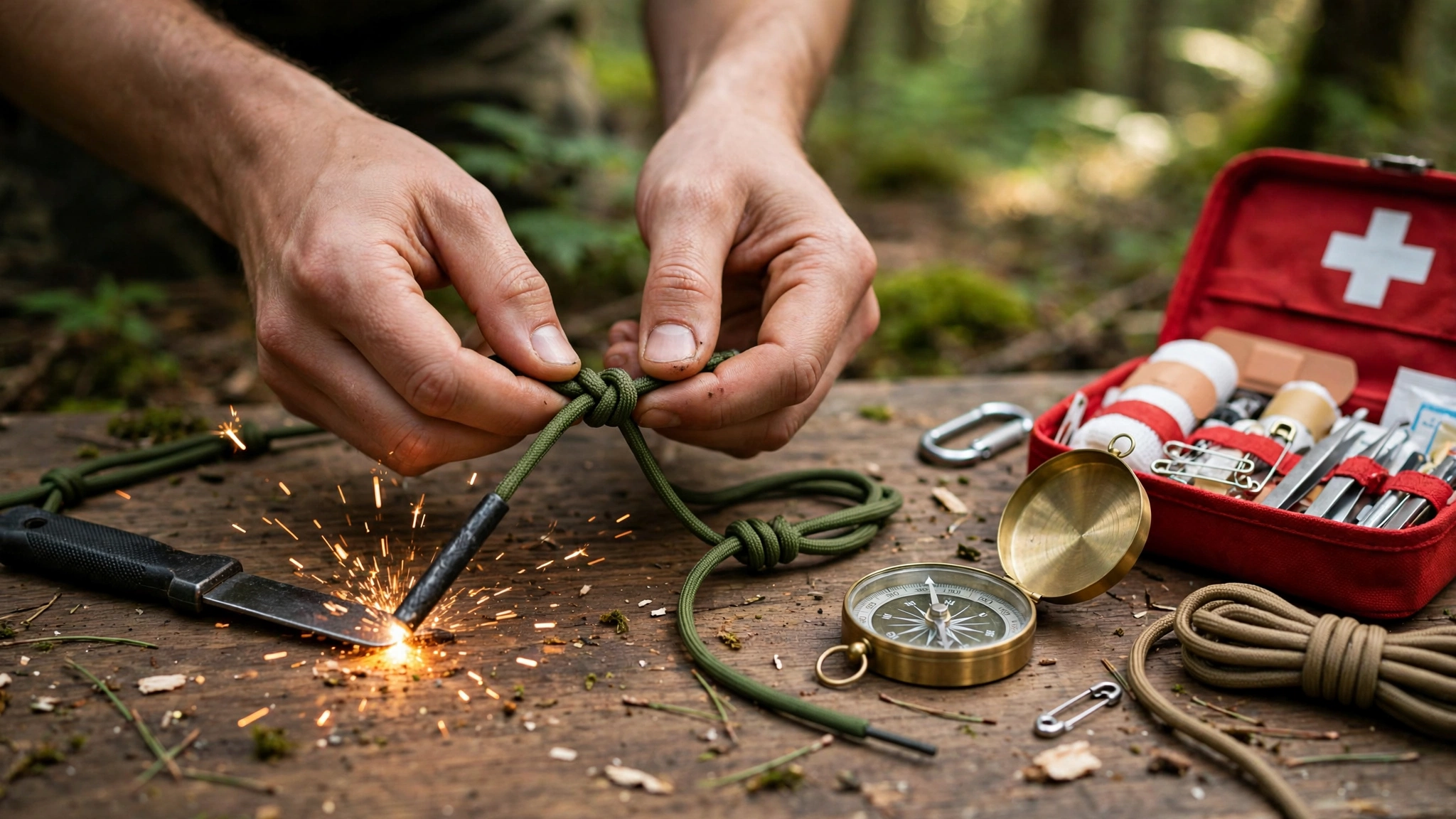
Every emergency kit has a cutting tool, and every kit owner has an opinion about which one it should be. The survival knife people say a multi-tool is a toy, and the multi-tool people say a big knife is a liability. The truth is that both are right, and both are wrong — because a knife and a multi-tool do different jobs, and the right choice depends on what you actually need to cut, open, and fix. This guide compares them honestly, explains when each one wins, and helps you decide what belongs in your kit — and what belongs at home, not in your pocket. One important note first: in Japan, carrying a bladed tool in public without a good reason can be a legal problem, so keep these tools in your kit at home, not in your pocket on the street. The rules are strict, and a good reason matters more than a good blade.
Survival knife vs multi-tool: the honest comparison
| Survival knife | Multi-tool | |
|---|---|---|
| Cutting power | Excellent — a long, strong blade cuts rope, wood, and food easily | Good for small jobs, but the blade is short and the handle is awkward |
| Other tools | None — it is a knife, and only a knife | Excellent — pliers, screwdrivers, scissors, can opener, file, and more |
| Size and weight | Bigger and heavier, needs a sheath | Small and light, fits in a pocket or a kit pouch |
| Repairs and fixes | Poor — it cuts, and that is all | Excellent — the pliers and screwdrivers fix most small problems |
| Food preparation | Excellent — a proper blade for cutting food | Usable, but slow and fiddly for real cooking |
| Safety | Needs care and a sheath — a loose knife in a bag is dangerous | Safer to carry and store, with the tools folded away |
| Cost | Low to high — a good one costs more than a cheap multi-tool | Low to high — a good one is an investment, a cheap one is a disappointment |
The pattern is clear. A knife is better at cutting. A multi-tool is better at everything else. And in a small apartment in a blackout, the everything-else jobs are the ones that come up most often: opening a tin, tightening a screw, cutting a piece of cord, pulling a splinter, fixing a torch, or trimming a piece of tape. A knife cannot do any of those. A multi-tool can do all of them, and it can still cut rope and open boxes. That is why, for most households, the multi-tool is the right first choice — see our multi-tool buying guide for how to choose one. A survival knife is the right second choice, for the household that already has a multi-tool and wants a proper blade for heavier work: cutting wood, preparing food, or building a shelter. It is not the right first choice, and it is not the right only choice.
Choosing, using, and keeping your tools safe
Choose a multi-tool the way you would choose any tool: by the tools you will actually use, not by the number of tools on the box. A good multi-tool has strong pliers, a locking blade, a can opener, a flat screwdriver, and scissors — and it feels solid in your hand, not rattly and loose. Cheap multi-tools break at the worst moment, usually at the pliers, so buy the best one you can afford and treat it as a long-term purchase. Choose a survival knife the same way: a fixed blade, about ten to fifteen centimetres long, with a full tang — meaning the metal of the blade runs all the way through the handle — and a sheath that covers the blade completely. A folding knife is a compromise: easier to carry, weaker than a fixed blade, and more likely to close on your fingers. Keep both tools sharp, because a blunt blade is more dangerous than a sharp one: it slips, and it needs more force. Learn to sharpen a blade with a simple whetstone or a pull-through sharpener, and keep the sharpener in the kit. And keep the tools clean and dry: wipe them after use, oil the joints of the multi-tool now and then, and store them where children cannot reach them. See our knife safety guide and our car emergency kit checklist. The common mistakes are simple: buying the cheapest multi-tool, which breaks; buying a huge knife you never use, which sits in a drawer; and carrying a blade in public, which can get you into trouble. A multi-tool in the kit, a knife in its sheath at home, and a sharpener in the same box — that is the cutting kit done.
Shop knife and multi-tool basics
- Quality multi-tools with pliers and locking blades — the one tool that does a dozen jobs.
- Fixed-blade survival knives with sheaths — a proper blade for heavier cutting work.
- Portable knife sharpeners and whetstones — a sharp blade is a safe blade.
As an Amazon Associate, Alien Bunker earns from qualifying purchases. This page contains affiliate links, which support the site at no extra cost to you.