
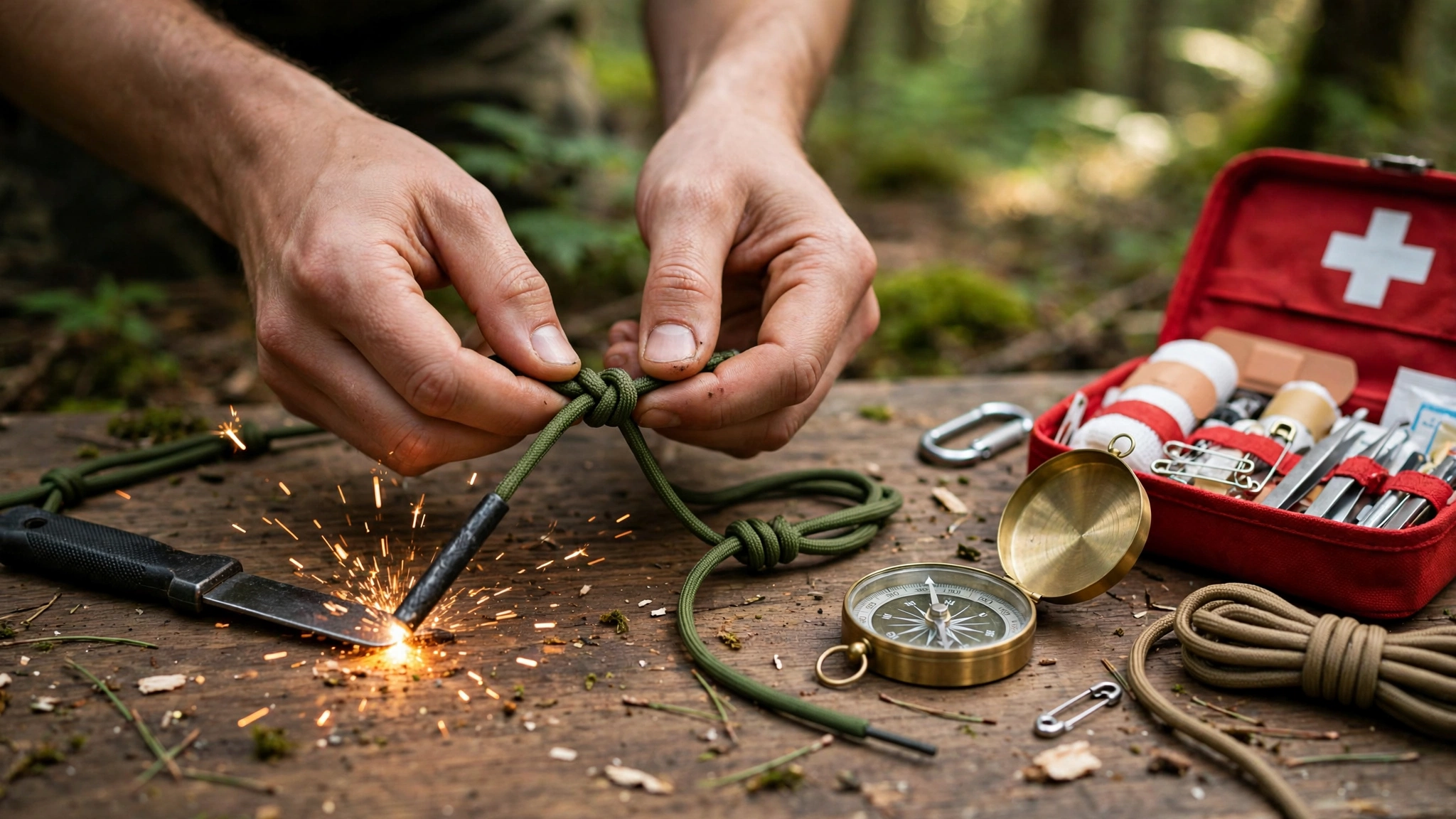
A knife is one of the most useful tools in an emergency kit and also one of the most likely to hurt you. It cuts rope, opens packaging, prepares food, trims a splint, and does a hundred small jobs that no other tool does as well. It is also the tool most people use carelessly, because a knife feels simple — until a dull blade slips, a folding knife closes on a finger, or a knife left loose in a bag cuts the hand that reaches in for it. Knife safety is not about fear. It is about a handful of habits that keep a useful tool from becoming an injury.
Choosing a knife: simple, sturdy, and the right size
For emergency use, the best knife is a simple one. A fixed-blade knife with a blade of around 8 to 10 centimetres is the standard choice: it is strong, it cannot fold shut on your fingers, and it is big enough for real work without being unwieldy. A folding knife is more compact and easier to carry, but it needs a reliable locking mechanism — a folder that closes unexpectedly is one of the most common causes of knife injuries — and it is harder to clean. A multi-tool with a knife blade, as covered in our multi-tool guide, is a good alternative if you want one tool that does many jobs, but a dedicated knife is better for heavy cutting. Avoid novelty knives, very cheap blades, and oversized blades: a cheap knife with a loose handle or a soft blade is dangerous because it slips and breaks, and a huge blade is harder to control. A plain, sharp, well-made knife with a comfortable handle is all you need. Keep it in a sheath or a protective case, always, when it is not in use — a knife loose in a bag or a drawer is an accident waiting to happen. And know the law where you live: in many places, including Japan, carrying a bladed tool in public without a legitimate reason is an offence, so keep the knife in the kit at home or in the go-bag for genuine emergency use, not in a pocket on an ordinary day.
Using a knife safely: the habits that prevent injuries
Safe knife use comes down to a few habits, practised until they are automatic. First, cut away from your body, always — never pull a blade toward yourself, and never cut with your free hand in the path of the blade. Second, keep the blade sharp: a sharp knife cuts cleanly with little force, while a dull knife needs force, and force is what makes a blade slip. Sharpen the knife regularly with a whetstone or a sharpening tool, and test it on paper — a sharp knife slices paper cleanly. Third, keep your free hand behind the blade and your fingers curled away from the cutting edge, and never try to catch a falling knife — step back and let it drop. Fourth, pass a knife handle-first, with the blade pointing down, and never throw a knife or hand it to someone who is not looking. Fifth, work on a stable surface with good light, and never cut when you are rushed, tired, or in the dark — most knife injuries happen when someone is hurrying. After use, clean the blade, dry it, and put it back in its sheath before you do anything else. Store the knife out of reach of small children, and teach older children that a knife is a tool, not a toy, and that it is only used with an adult present. The same careful approach applies to the rest of the kit: our bug-out bag guide and our car kit checklist both list the knife alongside the other sharp and heavy tools, where safe storage is part of the packing. A knife that is respected, kept sharp, and kept sheathed is a tool you will use for years without a single injury.
Shop knife safety basics
- Fixed-blade knives with sheaths — sturdy, simple, and safe to store.
- Whetstones for sharpening — a sharp knife is a safe knife.
- Cut-resistant gloves — extra protection while you learn safe handling.
As an Amazon Associate, Alien Bunker earns from qualifying purchases. This page contains affiliate links, which support the site at no extra cost to you.