
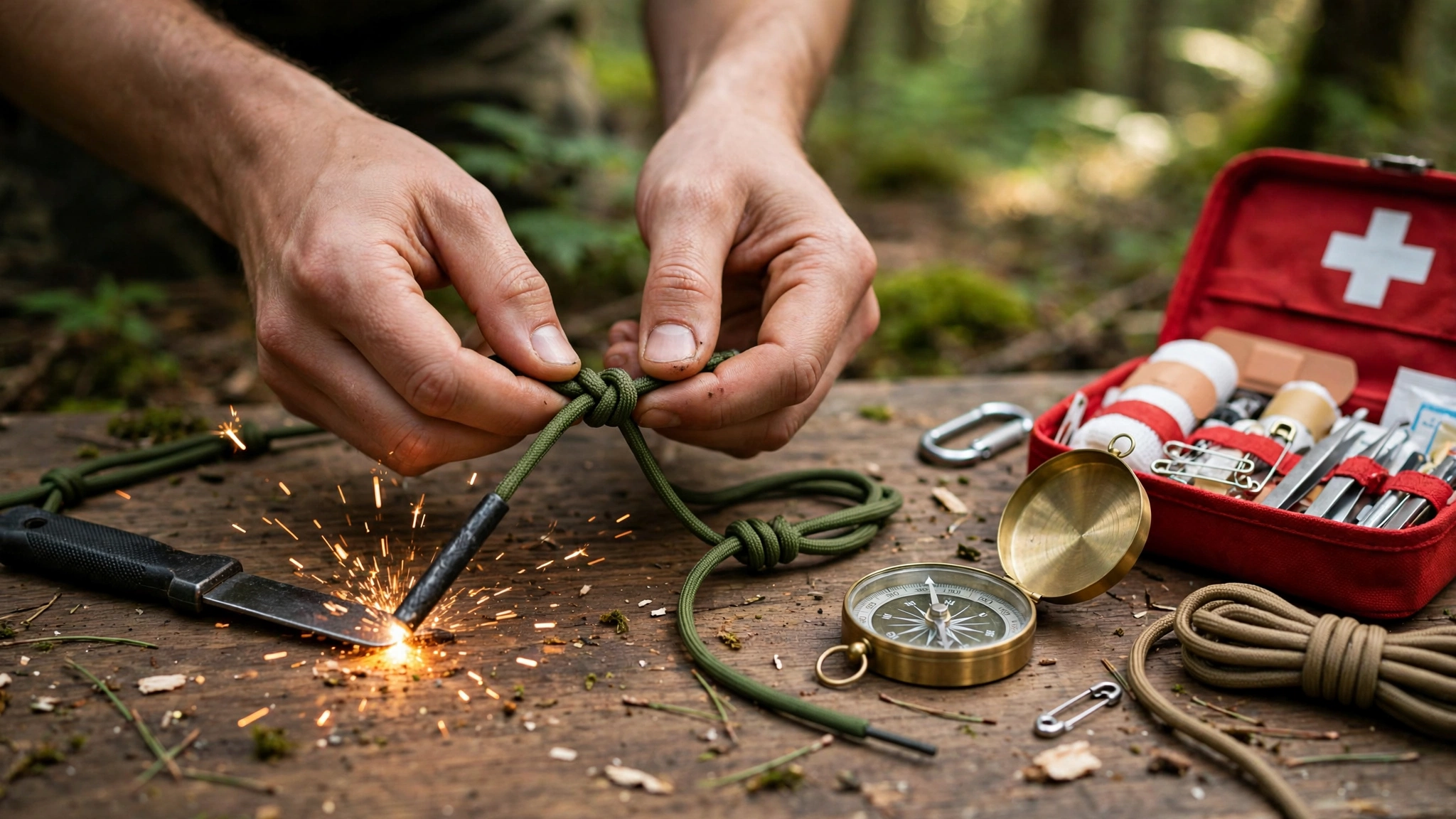
A hatchet is one of the most useful tools in an emergency kit, and one of the most dangerous. It splits wood for a fire, clears fallen branches from a path, cuts rope and cord, and breaks through a jammed door or window if you need to get out. Most hatchet injuries are not dramatic: they are a cut shin from a missed swing, a sliced finger from a loose sheath, or a deep cut from a hatchet left loose in a bag. All of them are preventable. This guide covers choosing a hatchet, using it safely, and storing it so it never hurts anyone in your household.
Choosing a hatchet: size, weight, and the sheath that matters most
For a small apartment, a hatchet is the right choice — not a full-size axe. A hatchet is a one-handed tool, about 35 to 45 centimetres long, with a head of about half a kilo to a kilo. It is small enough to store in a kit, light enough to use for a long time, and strong enough for the jobs you will actually face: splitting small logs, cutting branches, and clearing debris. When you buy a hatchet, the head matters less than the handle and the sheath. The handle should be solid, comfortable, and free of cracks — fibreglass handles are tough and weatherproof, while hickory handles are traditional and absorb shock well. The sheath matters most of all: a hatchet without a sheath is a blade loose in your kit, and it will cut someone. Buy a hatchet that comes with a proper sheath that covers the whole blade, and never store or carry the hatchet without it. A good hatchet costs more than a cheap one, but it is a tool you will own for decades — see our knife safety guide and our knife vs multi-tool guide for the same thinking applied to blades.
Using a hatchet safely: the rules that prevent injuries
Most hatchet injuries happen because the user breaks one of a few simple rules. First, always use a chopping block: a thick, flat piece of wood, on the ground, with the piece you are cutting resting on it. Never chop wood held in your hand, and never chop on a hard surface like concrete, which will bounce the blade back at you. Second, always swing away from your body, and always keep your feet and legs out of the swing path. Kneel, rather than standing, when you split small wood — a kneeling swing cannot reach your shins. Third, clear the area: make sure nobody is standing close by, and make sure there is nothing behind you that the handle can hit. Fourth, keep the blade sharp: a blunt hatchet is more dangerous than a sharp one, because it bounces off the wood instead of biting into it, and it needs more force. Fifth, wear gloves and eye protection: a pair of work gloves protects your hands from splinters and blisters, and safety glasses protect your eyes from flying chips. If you need to clear debris after a storm, see our shelter building guide and our fire starting guide for the jobs a hatchet is actually for.
Storing a hatchet in a small apartment
Storage is where most households get it wrong. A hatchet in a flat must be sheathed, dry, and out of reach of children — those three things are non-negotiable. Keep the sheath on at all times, even when the hatchet is sitting on a shelf: a sheath that is off is a blade that is exposed. Keep it in a dry place, off the floor, and away from damp: a hatchet left in a damp cupboard will rust, and a rusty blade is a dull blade. Oil the head lightly once or twice a year with a drop of machine oil, and check the handle for cracks every time you use it — a cracked handle can snap mid-swing. Keep the hatchet with the rest of the emergency kit, not scattered in a drawer with the kitchen knives, so you can find it in the dark. And if there are children in the household, the hatchet lives on a high shelf, in a locked cupboard, or in a bag they cannot open — never in a place a child can reach. A hatchet is a tool, not a toy, and the household should treat it that way. The common mistakes are simple: buying the cheapest hatchet, which has a loose head; storing it without a sheath; and using it without gloves or eye protection. A good hatchet, used with care, is one of the most useful tools you will ever own — and used without care, it is one of the most dangerous. The difference is a sheath, a chopping block, and five minutes of patience.
Shop hatchet safety basics
- Camping hatchets with sheaths — one-handed, with a proper sheath that covers the blade.
- Portable axe sharpening stones — a sharp blade is a safe blade.
- Heavy-duty work gloves — protection for hands, splinters, and blisters.
As an Amazon Associate, Alien Bunker earns from qualifying purchases. This page contains affiliate links, which support the site at no extra cost to you.