
In most emergencies, the first thing that fails is not the power or the water. It is communication. Mobile networks overload, batteries die, family members are in different places, and nobody knows who is safe, where to meet, or who to call. An emergency communication plan answers those questions in advance, on a calm day, so a stressful day is not spent guessing. It is the cheapest, simplest preparedness step a family can take, and it costs nothing but an evening of conversation.
Step 1: pick an out-of-area contact
When local networks are overloaded, calling someone nearby often fails while calling someone far away succeeds, because the call travels a different route. Pick one out-of-area contact — a relative or trusted friend in another city or region — and make that person the family’s message hub. Every family member calls or texts that person to report that they are safe and where they are, and the hub passes messages between family members who cannot reach each other directly. Write the contact’s name and number on paper, not just in a phone, and make sure every family member, including children old enough to use a phone, knows it. Put the same number in the child’s backpack contact card from our kids’ backpack guide.
Step 2: agree on meeting points, two of them
Agree on two meeting points: one near home, for a house fire or a local incident — a neighbour’s house, a park entrance, a shop doorway — and one outside your neighbourhood, for an evacuation that closes your area — a relative’s home, a school, a community centre. Everyone should know both points and how to get to each one without a phone, including children. Walk to the near meeting point together once, so it is a real place in everyone’s memory, not just an address on a card. If you cannot reach the first point, go to the second. If you cannot reach either, contact the out-of-area hub. That chain — meeting point one, meeting point two, out-of-area contact — covers almost every communication failure.
Step 3: decide how you will actually communicate
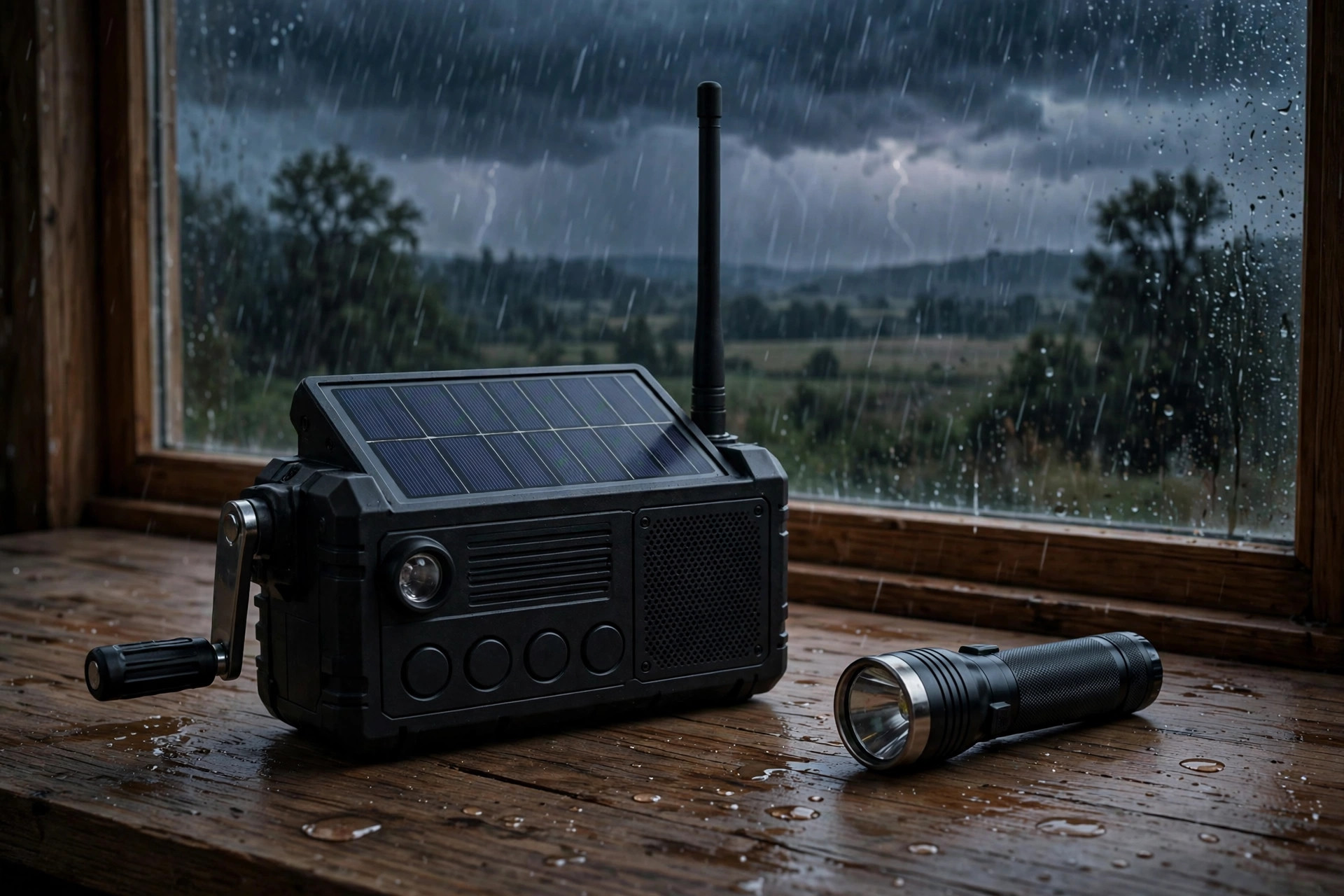
Do not assume mobile phones will work. Plan in layers. First, text messages, which often get through when voice calls do not, because they need less network capacity and can wait for a gap. Second, a messaging app with a group chat for the whole family, set up in advance, so one message reaches everyone. Third, a battery or hand-crank radio for official information when networks are down — our radio guide covers choosing one. Fourth, for households that want a backup beyond phones, simple two-way radios for short-range contact between family members in the same area. Whatever layers you choose, agree on a check-in rhythm in advance: for example, every family member messages the hub at the top of each hour during an emergency, so silence itself becomes information.
Step 4: write it down, and keep it where phones are not
A plan stored only in a phone dies with the phone’s battery. Write the plan on paper: every family member’s number, the out-of-area contact, both meeting points, the check-in rhythm, and any medical information that matters if someone else needs to help. Keep a copy on the fridge, a copy in each go-bag, and a copy in the car. Our 72-hour kit guide and car kit guide both have a place for exactly this card. Photograph the card too, so a copy lives in everyone’s phone gallery even if the paper is lost. Update the card when numbers or meeting points change, and review the whole plan once a year as a family — a plan nobody remembers is not a plan.
Step 5: practise once, then stop worrying about it
Run the plan once, as a family, on a normal weekend. Everyone leaves the house, goes to the near meeting point, messages the out-of-area contact, and meets up again. Time it, note what went wrong, fix the card, and you are done. Children in particular benefit from this rehearsal: an evacuation they have practised is far less frightening than one they have only imagined. After that one practice, the plan can sit quietly in its bags and on its fridge, ready but not nagging. That is the point of a communication plan — not to make a family anxious, but to let them stop being anxious about the one thing they can fully control: how they will find each other.
Shop the communication kit
- A hand-crank emergency radio — official information when networks fail.
- Family two-way radios — short-range contact without a mobile network.
- A large portable power bank — keeps phones alive for check-ins.
As an Amazon Associate, Alien Bunker earns from qualifying purchases. This page contains affiliate links, which support the site at no extra cost to you.