
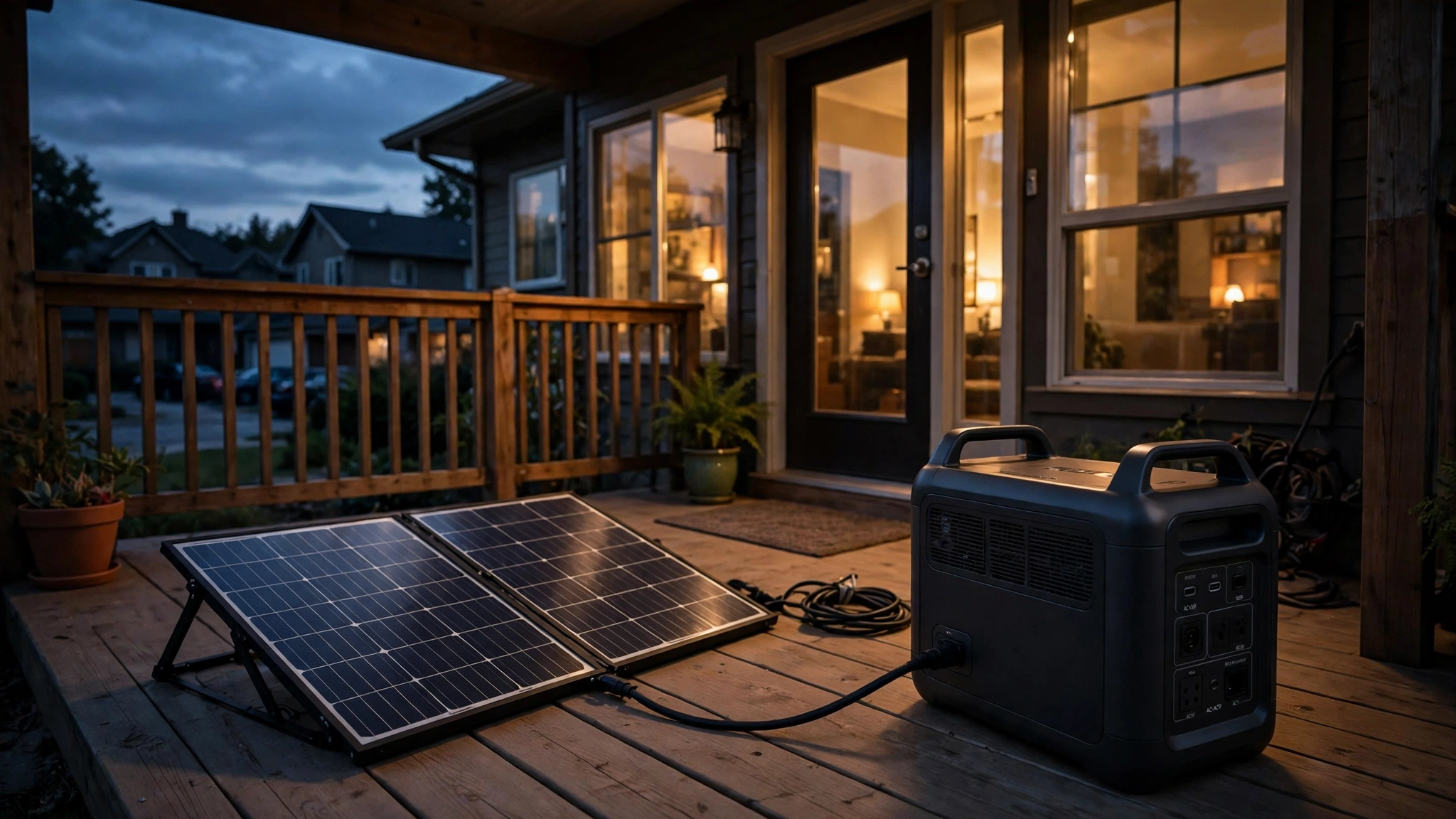
A solar power bank sounds like the perfect emergency gadget: a battery you can recharge from the sun, so your phone never dies in a blackout. The reality is more modest, and knowing that before you buy is the difference between a useful tool and a disappointing one. A solar power bank is genuinely useful in an emergency — but mainly as a battery pack that happens to have a small solar panel, not as a solar charger that happens to have a battery. This guide explains what to look for, what the numbers mean, and how to use one properly.
Capacity: what the mAh number actually means
Capacity is measured in milliamp-hours, or mAh, and it tells you how much charge the bank holds. A typical phone battery is around 3,000 to 5,000 mAh, so a 10,000 mAh bank holds roughly two full phone charges, and a 20,000 mAh bank holds roughly four — in practice a little less, because some energy is always lost in conversion and the bank’s own circuitry uses power. For emergency use, 10,000 mAh is a sensible minimum for one person, and 20,000 mAh is better for a household or for several days without power, though it is heavier and takes longer to recharge. Ignore the absurd numbers on some cheap listings — a pocket-sized bank claiming 100,000 mAh is not telling the truth, and a fake capacity rating is a good sign the whole product is unreliable. Buy from a brand you recognise, read reviews that mention real charging tests rather than just unboxing photos, and remember that a power bank is only useful if it is charged before the emergency: keep it topped up, check it monthly, and recharge it after every use, as part of the same routine as our blackout checklist. A dead power bank in a blackout is just a paperweight.
The solar panel: trickle charge, not fast charge
The solar panel on a power bank is small, usually between 1 and 5 watts, and that sets a hard limit on what it can do. In bright, direct sunlight, a small panel might add a few percent of charge per hour — enough to keep a phone alive with occasional use over several days, but nowhere near enough to fully recharge a 20,000 mAh bank in a day. In cloudy weather, through a window, or in shade, it adds almost nothing. That does not make the panel useless: in a long outage, a slow trickle that keeps a phone alive for emergency calls is genuinely valuable, and it is the one feature that keeps working when the mains are down for days. But it does mean you should charge the bank from the mains before an emergency, and treat the solar panel as a top-up, not a primary charger. If you need serious solar charging, a separate folding solar panel — covered in our solar charger guide — charges far faster than any panel built into a power bank, and pairs well with the bank itself. Other features worth checking: multiple USB outputs so two devices can charge at once, USB-C input and output for modern phones, a built-in torch for finding the bank in the dark, and water and dust resistance if you plan to use it outdoors. Pass-through charging — charging the bank while it charges a phone — is a bonus, though not all banks support it safely.
Using a solar power bank in an emergency
In a blackout, use the bank strategically, not casually. Charge the phone that matters most first — the one with the emergency contacts, the radio app, or the torch — and put other phones on low-power mode, with brightness down and non-essential apps closed, so each charge lasts longer. Keep the bank itself in the sun during the day, panel facing up, and bring it inside at night. Do not leave it on a hot windowsill in summer, because heat damages batteries, and do not rely on it to power anything bigger than a phone or a small torch: a power bank will not run a laptop, a heater, or a fridge, and trying to do so wastes its charge. For those jobs you need a proper power station, as covered in our fridge and power guidance. Test the bank before you need it: charge a phone from empty, time how long it takes, leave the bank in the sun for an afternoon and see how much charge the panel adds, and note the results on the box. A tested bank with honest expectations is a reliable emergency tool; an untested bank with inflated promises is a disappointment waiting for the worst possible moment.
Shop solar power banks
- Solar power banks 20,000 mAh — several days of phone charging in one pack.
- Folding solar panels — far faster solar charging than a built-in panel.
- Braided USB-C cables — durable cables that survive the go-bag.
As an Amazon Associate, Alien Bunker earns from qualifying purchases. This page contains affiliate links, which support the site at no extra cost to you.